5
min read
Turning Career Center Activity Into Workforce Insight
See how associations can connect member career signals, employer demand, and labor-market context to make better workforce decisions.


See how associations can connect member career signals, employer demand, and labor-market context to make better workforce decisions.



Associations have a valuable source of workforce insight right inside their career centers. The searches members make, the roles employers post, and the credentials people pursue can reveal where careers are moving—and where the association can lead.
A job search, a resume update, an employer posting, and a completed credential each tell a small story. Together, these signals can offer a broader view of member interests, employer needs, and emerging opportunities to support the profession.
Turning career-center reporting into workforce insight begins with a few thoughtful questions about data associations already have. The result is a clearer view of where to focus programs, partnerships, and resources.
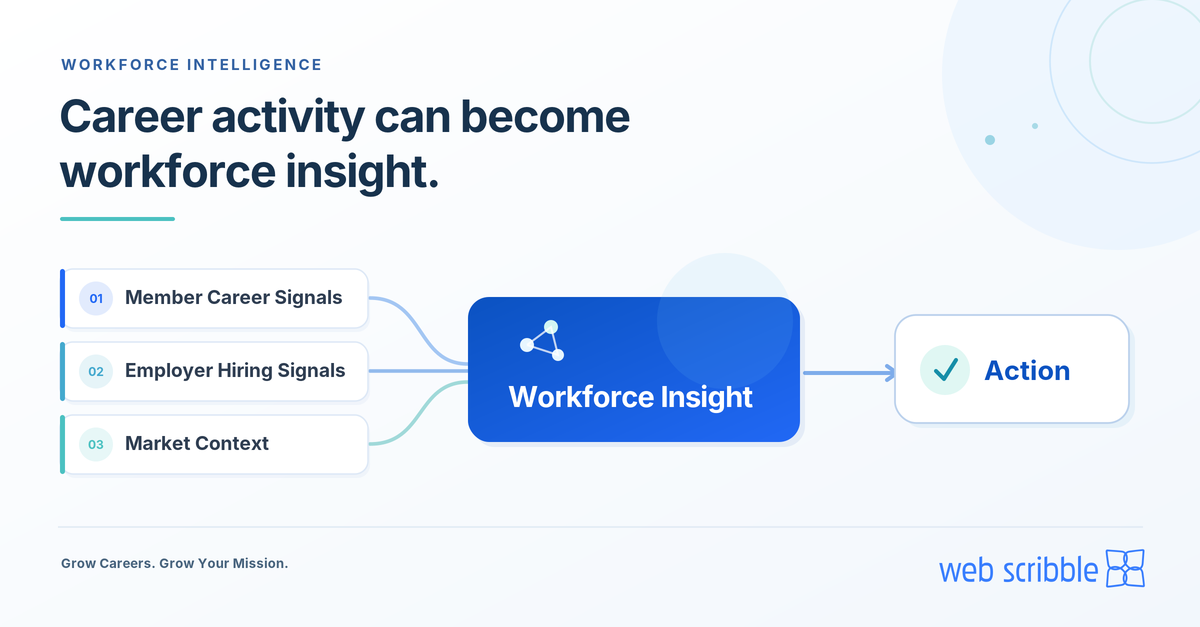
Start with the familiar dashboard: visits, job views, resumes, applications, postings, and revenue. These measures are valuable for managing a career center. Connecting them across member and employer activity creates another layer of value: a more informed picture of professional trends.
Consider two different findings:
The second observation adds context by connecting member interest with employer demand. It could reveal an opportunity for targeted education, a regional program, or a conversation with employers about evolving talent needs. It is a promising signal to explore, not proof of a shortage.
Web Scribble's Success Layer framework explores how individual career signals can improve the member journey. Looking at patterns across those signals opens up a complementary opportunity: learning more about the profession as a whole.
A practical starting point is a small set of indicators from each side of the career center.
Member-side indicators: repeated searches by specialty or location, saved job alerts, resume updates, interest in career paths, and relevant learning or credential milestones where systems are connected.
Employer-side indicators: the mix of advertised roles, locations and credentials requested, returning employers, job categories that attract interest, and roles that appear repeatedly.
Looking at both sides together makes the patterns more informative. Increased search activity might reflect career exploration, mobility, market uncertainty, or a successful outreach campaign. Increased postings might reflect employer growth, replacement hiring, seasonal demand, or improved employer engagement. Each possibility points toward a useful follow-up question.
The opportunity is to compare movements over time. For example, if employers increasingly advertise for a specific certification while members are exploring related courses, the association has a concrete reason to bring education, membership, and employer-relations teams into one conversation.
The Association-Employer Engagement Maturity Model describes how employer relationships can grow from individual postings into ongoing workforce partnerships. Career-center data offers another way to deepen those relationships: understand what employers are seeking and identify where the association can help members prepare and advance.
Career-center activity offers a timely, first-hand view of the members and employers using the service. Pairing that view with information about audience, channel mix, promotion, data collection, and time period helps make emerging patterns more meaningful—and keeps the conclusions appropriately grounded.
Compare those patterns with a larger external source when possible. The Bureau of Labor Statistics Job Openings and Labor Turnover Survey offers national and industry context. Its August 2026 report counted approximately 7.1 million U.S. job openings, but that national number cannot answer how hiring feels to a particular specialty or professional community. Occupational employment and wage data can provide a different complementary view.
Present the insight in three parts: what the data shows, what it may suggest, and what deserves a closer look. Consistent definitions make comparisons stronger. Aggregated reporting also protects members' privacy; for small specialties or groups, use reporting thresholds or broader categories so no individual's job search, resume, or career intentions can be inferred.
The greatest value comes when an insight helps an association choose its next action—whether that's refining education, developing an employer partnership, or strengthening member support.
A simple monthly workforce-insight review can follow four questions:
Imagine a professional association noticing growing employer interest in a skill that members are also exploring. That creates an opportunity to ask members about their goals, speak with employers about expectations, and test a focused educational offering. The data provides a starting point for a timely, evidence-informed program—not a definitive claim about the labor market.
It also creates a richer board conversation. Alongside career-center performance, leadership can share what it is learning about the profession, which opportunities it is pursuing, and how it will measure progress.
The Association Career Technology Stack provides a useful next read for teams exploring how career, membership, community, and learning systems can make those signals more actionable.
Begin with one specialty, one comparison period, and one opportunity to act. A focused, repeatable insight can help leadership build confidence in this approach and expand it over time.
For more practical approaches to making career metrics useful to leadership, explore Web Scribble Academy's webinars and resources.