5
min read
A Board-Ready Career Center Report: What to Measure and Why It Matters
Turn career-center activity into a one-page association board report covering member progress, workforce health, and decisions that matter.


Turn career-center activity into a one-page association board report covering member progress, workforce health, and decisions that matter.



Association career centers generate a steady stream of useful information about members, employers, and career opportunities. Bringing a few of those measures together creates a powerful opportunity: showing the board how career services support member progress, a healthy profession, and the association's long-term strength.
Visits, job postings, resume uploads, and revenue are useful operational measures. When paired with a few outcome-oriented indicators, they also help leadership connect day-to-day activity with the association's broader mission and strategic priorities.
The good news is that this story can start with a focused, one-page report built around outcomes. Associations can begin with measures they already track and make the presentation more meaningful with a clear interpretation and next step.
Begin with the opportunity in front of the board. Could career-center insight help prioritize professional development, guide an employer partnership, inform an investment, or reveal an emerging workforce need?
The answer determines what deserves space in the report.
For example, growing job views show increasing use of the career center. Pairing that activity with signs of continued engagement—such as early-career members activating job alerts after onboarding or employers returning for a second recruiting campaign—makes the story even stronger. These measures do not establish retention or hiring outcomes on their own, but they reveal progress in areas the association can influence.
The most useful report builds a bridge from the observable change to its significance and then to a decision leadership can make.
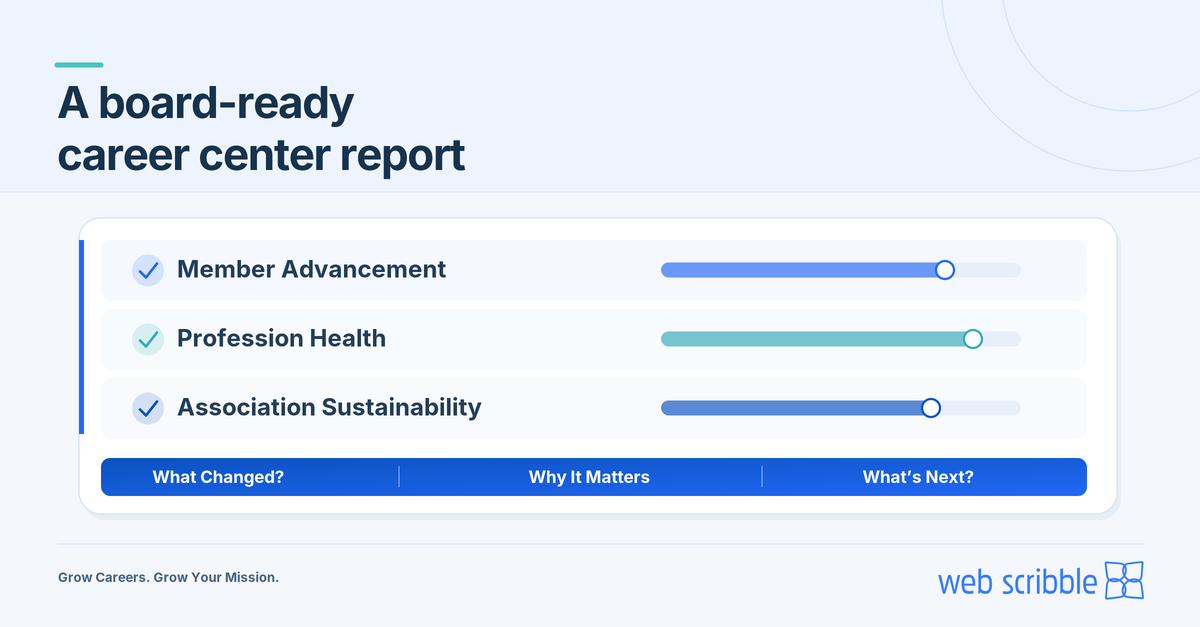
Three outcome areas offer a flexible starting point. Each association can choose the indicators that reflect its members, profession, and strategic goals.
Choose one or two indicators of meaningful career progress. Depending on the systems available, these might include first-time career-center activation, repeat use of targeted career services, credential-to-career engagement, mentoring participation, or a voluntary member-reported career milestone.
Taken together, these indicators help tell a story of career momentum: how members discover services, take a next step, and continue engaging. They also help identify opportunities to make that progression easier.
For example, strong participation in early-career orientation creates a natural opportunity to introduce personalized job alerts, mentoring, or other career tools. Reporting how many members take that next step gives leadership a practical measure of progress.
Employer participation can reveal where an association is strengthening connections between professionals and organizations that hire them. Useful measures might include repeat employer engagement, active demand by specialty, participation in career programming, and the mix of opportunities available to members.
Show the difference between member interest and employer demand when data supports it. If one specialty attracts concentrated demand, leadership may choose to commission deeper research, invite employers into a discussion, or adjust educational programming.
These signals become even more useful alongside formal labor-market analysis. BLS occupational employment and wage data can provide broader context for what the association is seeing among its own members and employers.
Career centers can strengthen the association's mission and financial sustainability at the same time. Pairing a revenue measure with a member- or employer-value measure—for example, non-dues revenue alongside repeat employer participation—makes both contributions visible.
A balanced report presents revenue and member value as related, but distinct, measures. That creates a useful discussion about investments and experiences that can strengthen both over time.
Web Scribble's Employer Engagement Maturity Model offers a framework for understanding whether employer activity is developing into longer-term, member-aligned partnerships.
A useful board report can have five compact sections:
| Section | What to show |
|---|---|
| Outcome | The member outcome, workforce impact, or association result you're looking for |
| Metric | One clearly defined indicator, compared with a relevant prior period |
| Interpretation | What changed, including caveats and possible causes |
| Action taken | What staff already tried, improved, or learned |
| Decision requested | What the board should approve, fund, ask, or monitor next |
For each metric, show the baseline, the current result, and the comparison period. Include the eligible audience when it helps interpretation: "60 members started using career alerts" carries different meaning in a group of 100 eligible members than in a group of 10,000. Clearly labeled gaps or limitations make the report more trustworthy.
Distinguish direct evidence from promising indicators. Where the association is still developing ways to connect career engagement with renewal, employment, or financial results, the board can see that measurement work as a practical next investment.
Credible, well-explained measures give the board the confidence to make thoughtful decisions.
Imagine an association reporting that career-center activity increased 18% after a fall awareness campaign. That is a useful sign of growing interest—and a starting point for understanding what members choose to do next.
A board-ready version might say: "Our awareness campaign brought more members to the career center. Our next opportunity is to turn that interest into continued career engagement. We're testing personalized follow-up and will measure how many members take a second career action next quarter."
The percentage here is illustrative, not a Web Scribble benchmark. The reporting approach turns a positive operational result into an opportunity to learn, improve the experience, and guide a future decision.
The same approach works for employer results. Job-posting growth becomes an even richer story when paired with repeat employer participation, emerging skill needs, and the ways the association is making recruiting more valuable.
A practical presentation can close with three questions that invite the board into the next opportunity:
Those questions make career-center reporting a useful part of governance. They position the career center as a way to support member advancement, connect employers with talent, and strengthen the profession.
For additional ways to connect career activity to association priorities, see Web Scribble's Success Layer framework and seven workforce questions for association leaders.
Start with three outcome areas, one clear measure for each, and a decision your board can make from the evidence. That simple format gives leaders a foundation to build on as their reporting matures.
For practical education on presenting career metrics to leadership, explore Web Scribble Academy's webinar resources.
Featured photo by Matthew Osborn on Unsplash.