6
min read
Connecting Career Activity Back to iMIS: A Practical Data Framework
Explore how associations can connect meaningful career-center activity to iMIS, support member needs, and use a practical 90-day integration framework.


Explore how associations can connect meaningful career-center activity to iMIS, support member needs, and use a practical 90-day integration framework.



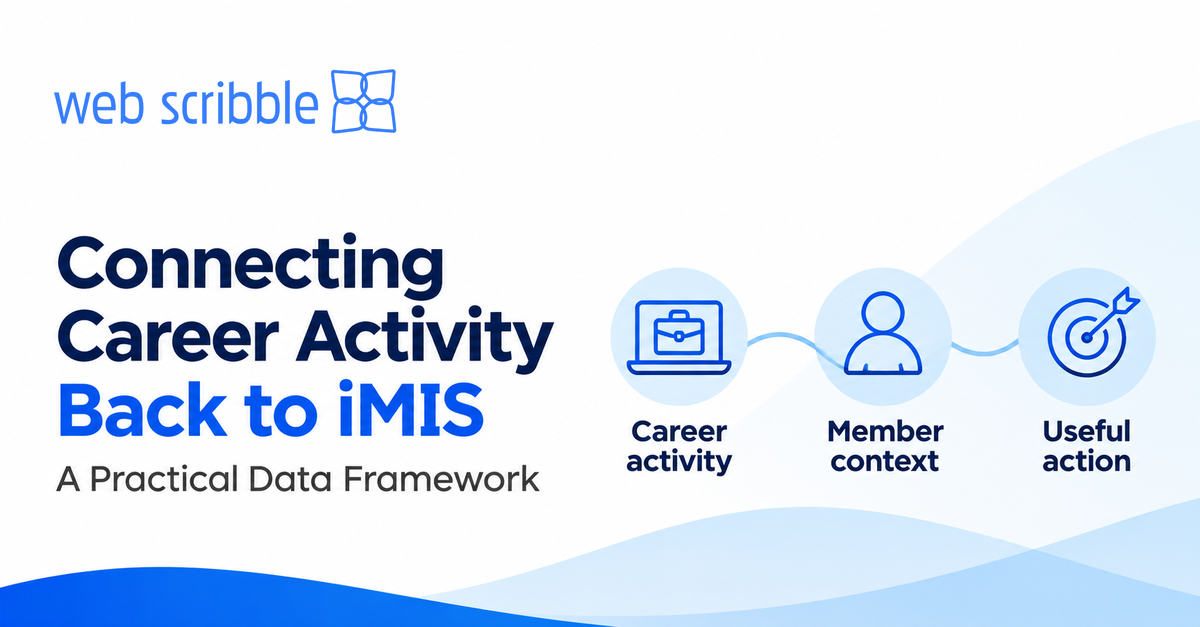
Career-center activity can help associations understand what members need next. The useful question is which signals belong in the member record—and what your team will do with them. Members don't organize their careers according to an association's technology stack. Someone might update a resume in the career center, search for a new role, register for a course, and ask a question in the community. To that member, these are parts of the same professional journey. To the association, they can appear as unrelated activities in separate systems.
For associations using iMIS, there's an opportunity to make career engagement part of a fuller picture of member needs. Web Scribble's Premier iMIS Marketplace listing identifies career data, activity data, and product purchases as part of the integration story; the exact data used still depends on the association's implementation. The objective isn't to collect every click. It's to connect the right information to a practical response.
Single sign-on is an important first step. It can reduce the friction of accessing career services and help the association maintain a consistent member identity. But convenient access and useful insight are different outcomes. A member might search for management roles because they're considering a career transition. Another might upload a new resume while preparing for a certification. A third might explore internship opportunities early in their career. Each action is meaningful in context. None should be treated as proof that the association knows exactly what the member wants.
A better approach starts by asking: What would our team do differently if we knew this activity had occurred?
The association can evaluate potential career-center data connections with three simple questions.
| Career signal | What it might suggest | A useful association response |
|---|---|---|
| Job search or job alert creation | A member is exploring opportunities in a particular field or role | Share relevant career resources or ask whether existing programs meet that need |
| Resume or career-profile update | A member is actively maintaining their professional profile | Offer coaching, credential information, or profile-completion help where appropriate |
| Career fair registration | Interest in employers or career mobility | Connect the event experience with relevant professional development and follow-up |
| Career-path or mentoring interest | A member may be exploring professional growth beyond an immediate job change | Recommend an appropriate mentoring, education, or community opportunity |
| Repeated interaction with career resources | Career support may be an important part of the member's relationship with the association | Review which resources deserve more attention or investment |
These are examples of useful signals, not a claim that every field or activity automatically syncs in every iMIS implementation. The exact events, data flow, permissions, and automation depend on the configuration.
A sound starting point is a narrow, documented set of activities that can support a real association decision. For each proposed data point, define:
This is where a shared approach between the association, its AMS team, and its career-center partner makes a difference. Integration planning should involve the people responsible for membership, education, career services, and reporting—not just the people who configure an API.
A connected view can serve two distinct purposes. For the member, it can help the association see a fuller picture of professional interests and offer a more relevant next step. Career support becomes part of the member experience rather than a separate service that must be rediscovered. For association leadership, aggregated activity can reveal where professional needs are changing. Are members increasingly exploring certain roles? Which career resources are being used? Where might education, mentoring, or employer partnerships add value?
Those questions can inform programming, member value, and decisions about how the career center contributes to the association's mission and non-dues revenue. For a complementary workforce-wide view of member and employer signals, see turning career-center activity into workforce insight. The strength of the analysis depends on the quality of the underlying data. An activity signal is a prompt for interpretation—not a diagnosis of a member's situation or proof of a business outcome.
Before requesting more integrations, try documenting one candidate signal as a short decision record. For example:
| Decision field | Example for an association using iMIS |
|---|---|
| Career activity | A member creates a job alert |
| Identity and timing | Match the activity to the correct member record and record when it occurred, if that connection is available and permitted |
| Possible meaning | The member may be monitoring opportunities, but the alert alone does not prove an active job search |
| Potential member response | Offer a relevant career resource or make that resource easier to discover |
| Responsible team | Membership or career-center team, with technical validation by the iMIS and career-center owners |
| Review measure | Whether the resource was used and whether members found the next step helpful |
That single record makes a decision explicit. It also exposes the questions that should be answered before an activity becomes a field, segment, automated message, or board metric. For an overview of the broader integration options, Web Scribble's AMS integrations page describes the role of career engagement data in connected association systems.
An association doesn't have to redesign its entire technology environment to make progress. First 30 days: Bring together the teams that own iMIS, the career center, membership, and professional development. Choose two or three career activities worth understanding. Document current data availability and existing permissions. Next 30 days: Confirm the technical options with your integration partners. Decide how the selected signals should be associated with the member record and what follow-up, if any, is appropriate.
Final 30 days: Review what the team learned. Did the selected information clarify member needs? Did it help staff offer a more relevant service or make a better decision? Keep useful signals, refine unclear ones, and avoid collecting activity without purpose. The goal isn't a bigger database. It's a more connected experience for members and more useful information for the association. The next step is to bring those findings into a board-ready career center report when leadership needs to decide what to fund, improve, or measure.
Web Scribble works with associations to connect career-center experiences with their broader technology and member-service strategies. If you're planning how career activity should fit into iMIS, let's map the member journey, the relevant signals, and one practical next step together. You can also explore Web Scribble's AMS integrations as a starting point.